A town center where the library is open, the college is part of public life and a first job can lead to a nearby home. A neighborhood with a path to the river and a useful connection to the city. A place where growing older does not mean leaving everyone you know.
That is a more demanding ambition than attracting new residents. It is also a more useful starting point for New England’s next chapter.
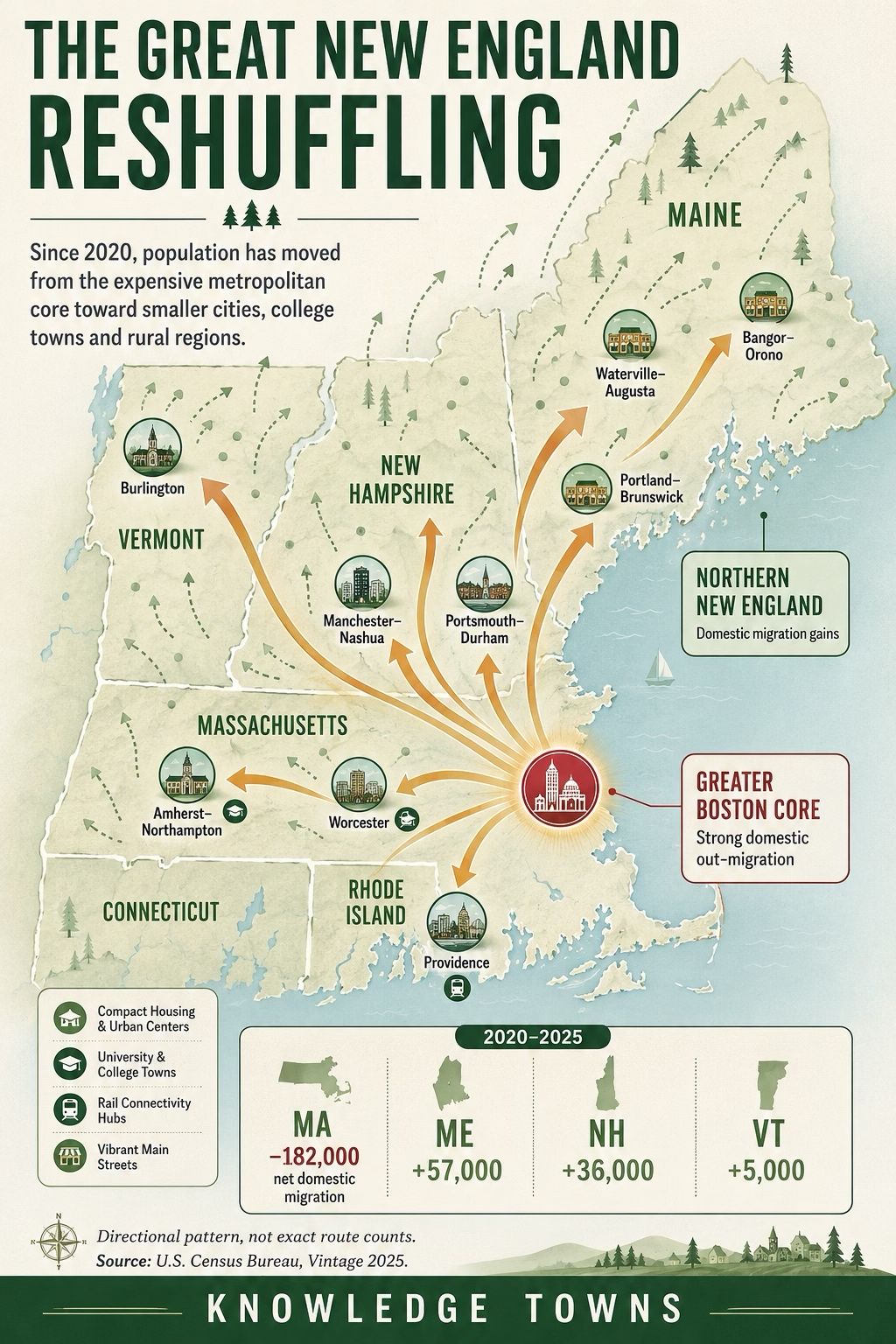
The infographic that began this discussion asks us to see the region as a network of places, not simply a metropolitan center surrounded by its commuter territory. The policy question is what would make that network work for the people already living in it.
What the numbers actually tell us
Summing the annual domestic-migration components in the Census Bureau’s Vintage 2025 dataset, from April 1, 2020 through July 1, 2025, gives Massachusetts a net domestic outflow of 182,145 people. Maine gained 56,775 through net domestic migration, New Hampshire 36,247 and Vermont 5,385. These are the rounded figures shown in the original graphic. Source: Census state population and components of change.
These figures measure moves into and out of each state from elsewhere in the United States. They are not total population change, which also includes births, deaths and international migration. Nor do they show that Massachusetts residents accounted for every gain in northern New England.
The map’s arrows are schematic. State totals cannot establish a Boston-to-college-town flow, identify particular destinations or explain why someone moved. Those questions require origin-and-destination evidence at a finer scale.
A bedroom community is not the only alternative
Proximity to Boston can be an advantage without becoming a town’s entire purpose. A connected urban village should offer access to the wider economy alongside reasons to spend time, work and participate locally.
A university can open its expertise to local firms. A hospital can help create paid routes into care work. A library can host continuing education. Homes above shops can bring people into the center throughout the day. None of these connections follows automatically from a change in population.
The distinction matters. If we only move households farther from expensive jobs, we may simply lengthen journeys and export housing pressure. If we connect housing, institutions and local work, smaller centers can become places of opportunity in their own right.
Three policy commitments to test
1. Add homes where daily life already has a center
Municipalities should identify walkable sites near existing services and anchors, test infrastructure and development costs, and make appropriate infill and reuse easier to deliver. Affordability, accessibility and protection against displacement belong in the initial brief, not as corrections after investment arrives.
The measure should be occupied homes serving a range of incomes and life stages, not theoretical zoning capacity.
2. Make institutional knowledge accessible
Colleges, healthcare employers, local firms and civic organizations should sponsor paid projects and visible career pathways. A resident should be able to understand the entry requirements, training costs, work experience and next qualification without navigating each institution separately.
This should serve incumbent residents and working adults as deliberately as newcomers. Growth that bypasses the local workforce is not shared prosperity.
3. Fund access, not just movement
Transport planning should start with essential journeys: home to class, clinical placement, workplace and childcare. Assess bus connections, safe walking and cycling, and regional services against actual schedules. A line on a map is not evidence that someone can reliably reach a shift.
Not every place needs the same transport solution. Each needs an honest account of who can reach opportunity and who cannot.
The strongest objection deserves an answer
Why encourage dispersal when metropolitan concentration can support specialized labor markets and collaboration?
The proposal is not to weaken Boston or relocate its economy by decree. It is to expand the number of places that can participate in regional prosperity. That requires testing whether investment in smaller centers creates additional opportunity rather than simply rearranging demand.
New arrivals can also strain housing, water systems and public services. A credible demonstration must count those costs and listen to residents who are not benefiting from growth.
Start with a demonstration, not a grand promise
The Institute proposes bringing willing communities and anchor institutions together around a small set of demonstration districts. Each should establish a baseline for housing costs, access to jobs and training, local business participation and infrastructure capacity.
Partners should publish a delivery plan, identify who is responsible for each commitment and report what changes. Evidence that the approach is failing should be as visible as evidence of success.
The ambition is not a region of miniature Bostons. It is a New England where more people can find both connection and belonging, without having to choose between opportunity and a life they can afford.
Move the idea forward
Contribute evidence—or nominate a place to test it
Tell us who you are, your connection to the issue or place, the challenge you are working on, and the evidence, counterargument or demonstration you can contribute.
- Evidence that strengthens or changes the argument
- A live policy or institutional challenge
- A community, campus or corridor that could test the proposition
- A decision or timetable that makes the work actionable
We review each submission. When there is a useful next step, we will respond within several days with a request for more information, a short exploratory call or an invitation to contribute to the work.
Prepare a contributionThe link opens a structured email. Please share links rather than confidential, sensitive or legally protected material.
Looking for commissioned place-based work? Visit Atlas ↗Knowledge Towns Advisory. Referenced organizations are examples or sources, not claimed Institute partners.