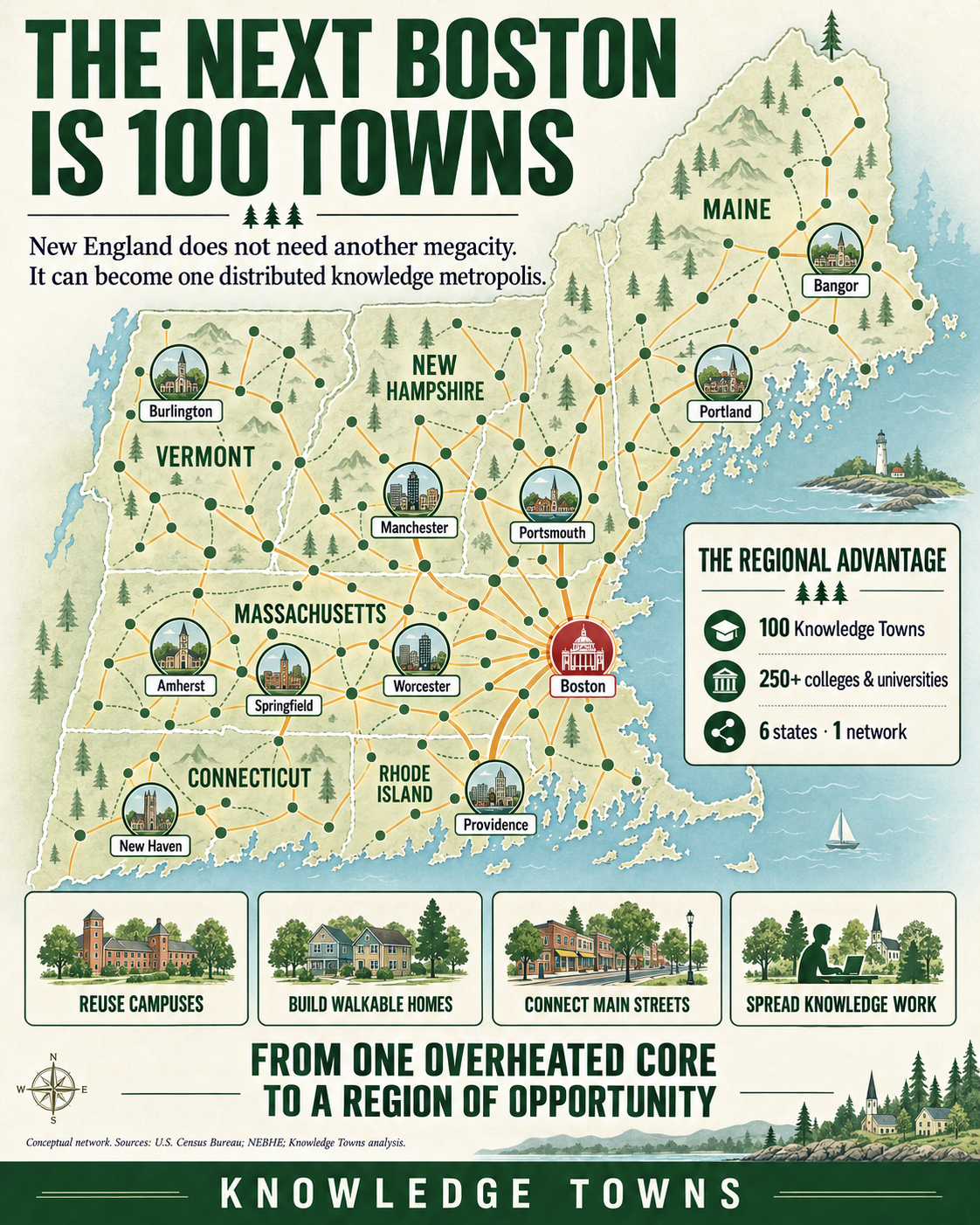
A hundred towns cannot become Boston merely by drawing lines between them. Specialized labor markets, repeated face-to-face contact and dense professional networks are difficult to reproduce across distance.
That is the strongest objection to the distributed-metropolis idea, and it is correct. The relevant question is smaller and more practical: which benefits can places share without becoming one continuous city?
Share capabilities, not just a brand
A town might offer access to manufacturing expertise; another a clinical learning environment; another an adult degree pathway. Residents should be able to use those complementary strengths without moving for every next step.
Regional cooperation is not hypothetical. The New England Board of Higher Education operates Tuition Break and the New England Transfer Guarantee, connecting educational access across institutional and state boundaries. These are specific mechanisms, not evidence that the wider Knowledge Town network already exists. NEBHE programs.
Policy inference: The next step is to connect educational cooperation to paid work, housing and practical travel. A shared course has limited value if the learner cannot reach the placement that follows it.
Build the first corridor from real journeys
1. Choose partners with complementary needs
Start with a few willing places and institutions, not a hundred-name membership list. Identify a workforce problem they cannot efficiently solve alone. Map existing programs, employers and barriers before commissioning new facilities.
2. Make participation portable
Partners should agree how learners enter, how appropriate credits are recognized, who supports them and who pays for delivery. Employers should contribute paid projects and placements. A shared navigator can help people cross administrative boundaries without eliminating institutional accountability.
3. Fund the connections people will use
Coordinate course and shift times with existing transport. Test targeted service improvements, safe access to stops and digital participation where appropriate. Do not promise a rail line because a conceptual map looks incomplete. An affordable bus connection that serves an actual journey can matter more than an unfunded regional diagram.
A network needs local life
The aim is not to produce more places from which people leave each morning. Each participating center should have a plan for housing, public rooms and local enterprise. External access and local participation should reinforce each other.
Evaluate total living costs rather than assuming that cheaper housing farther away is more affordable. EPA’s smart-growth guidance explicitly treats housing and transportation together and emphasizes access to existing community destinations. EPA: housing and access.
Who runs the network?
A time-limited agreement should assign a lead institution or regional body to coordinate the pilot. Partners retain responsibility for their own services. The agreement should publish contributions, fees, data-sharing limits and an exit process. A new permanent organization is not the starting requirement.
Seed support should fund coordination and evaluation; employers and institutions should identify which recurring services they can sustain. Do not use temporary grants to conceal an operating model with no continuing payer.
The scale-up test
After an initial academic year, measure completed pathways, paid placements, participant costs, travel reliability and employer reuse. Ask whether cooperation produced opportunities that would otherwise not have occurred. Expansion should follow demonstrated demand and committed delivery capacity.
The next Boston need not be another Boston. It could be a region where a person can remain rooted in one community while accessing more of what the region knows.
Move the idea forward
Contribute evidence—or nominate a place to test it
Tell us who you are, your connection to the issue or place, the challenge you are working on, and the evidence, counterargument or demonstration you can contribute.
- Evidence that strengthens or changes the argument
- A live policy or institutional challenge
- A community, campus or corridor that could test the proposition
- A decision or timetable that makes the work actionable
We review each submission. When there is a useful next step, we will respond within several days with a request for more information, a short exploratory call or an invitation to contribute to the work.
Prepare a contributionThe link opens a structured email. Please share links rather than confidential, sensitive or legally protected material.
Looking for commissioned place-based work? Visit Atlas ↗Knowledge Towns Advisory. Referenced organizations are examples or sources, not claimed Institute partners.