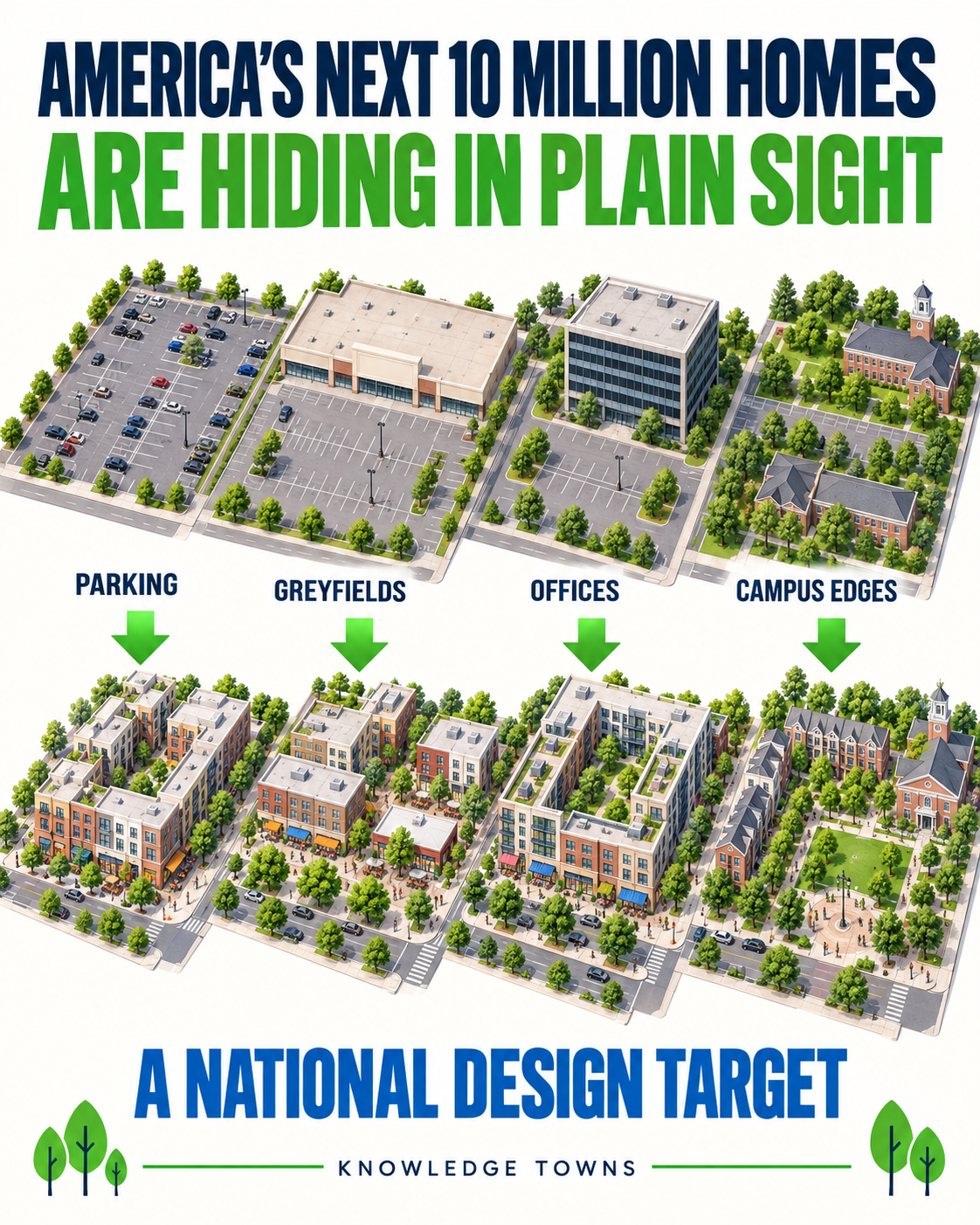
The strongest objection to the ten-million-home proposition is straightforward: a parking lot is not a development project, and an empty office is not an apartment building waiting for a new sign.
That objection should shape the policy. It should not end it. The task is to discover which sites can support good homes, remove avoidable barriers and invest where the resulting neighborhoods would make daily life work better.
Start with the location, not the building
The original graphic identifies four starting points: parking, aging commercial sites, offices and campus edges. These are categories for investigation, not interchangeable sources of housing. Some buildings will justify conversion. Others may require replacement, partial reuse or no intervention at all.
EPA’s housing guidance connects compact development and a wider range of housing types with access to existing destinations and transportation options. It also warns that desirable walkable neighborhoods can become more expensive. Location policy therefore needs affordability and anti-displacement measures, not just a persuasive rendering. EPA: Smart Growth and Housing.
A good site is not merely vacant. It has a plausible path to services, safe access, an economically workable project and homes that people need.
Turn the target into a pipeline
1. Inventory sites honestly
Municipalities and willing institutional owners should publish a short list with ownership, current use, infrastructure capacity, access, environmental constraints and a preliminary development range. Separate gross land area from the area actually available for housing. Do not count the same site as both an office conversion and a redevelopment.
2. Test the economics before offering a subsidy
Each candidate needs a comparison of reuse, replacement and continued operation. Include acquisition, structural work, utilities, accessibility, remediation, financing and ongoing maintenance. Test rents or sale prices that local households can support. A subsidy should address an identified public purpose and financing gap, not reward an inflated land price.
3. Make a complete neighborhood possible
Planning rules should allow appropriate housing types and mixed uses where infrastructure can support them. Streets, crossings, shade, public space and everyday services should be funded alongside buildings. Campus-edge projects should connect to the town, rather than becoming private residential compounds.
Who pays, and who benefits?
The proposed division is practical: owners contribute sites on negotiated terms; developers take delivery risk; municipalities coordinate public infrastructure; housing partners secure lasting affordability where public support is involved. Every agreement should identify maintenance obligations and public benefits before construction begins.
Public land is not free simply because no purchase check changes hands. Its opportunity cost and the value transferred to a private partner must be disclosed. Long leases can preserve ownership, but they are not automatically better than other structures.
A first-year demonstration
Start with a small, varied group of sites rather than promising a national total. During the first 90 days, select candidates and establish baseline costs. Over the next nine months, complete feasibility work, community review and procurement for viable projects. Report stalled and rejected sites as well as those advancing.
Measure homes financed and occupied, affordability duration, combined housing and travel costs, displacement, public subsidy per home and infrastructure liabilities. Approvals alone are not success.
Policy inference: The most useful national target may be one that changes local delivery habits. Ten million becomes credible only when thousands of independently workable projects can be counted beneath it.
Move the idea forward
Contribute evidence—or nominate a place to test it
Tell us who you are, your connection to the issue or place, the challenge you are working on, and the evidence, counterargument or demonstration you can contribute.
- Evidence that strengthens or changes the argument
- A live policy or institutional challenge
- A community, campus or corridor that could test the proposition
- A decision or timetable that makes the work actionable
We review each submission. When there is a useful next step, we will respond within several days with a request for more information, a short exploratory call or an invitation to contribute to the work.
Prepare a contributionThe link opens a structured email. Please share links rather than confidential, sensitive or legally protected material.
Looking for commissioned place-based work? Visit Atlas ↗Knowledge Towns Advisory. Referenced organizations are examples or sources, not claimed Institute partners.