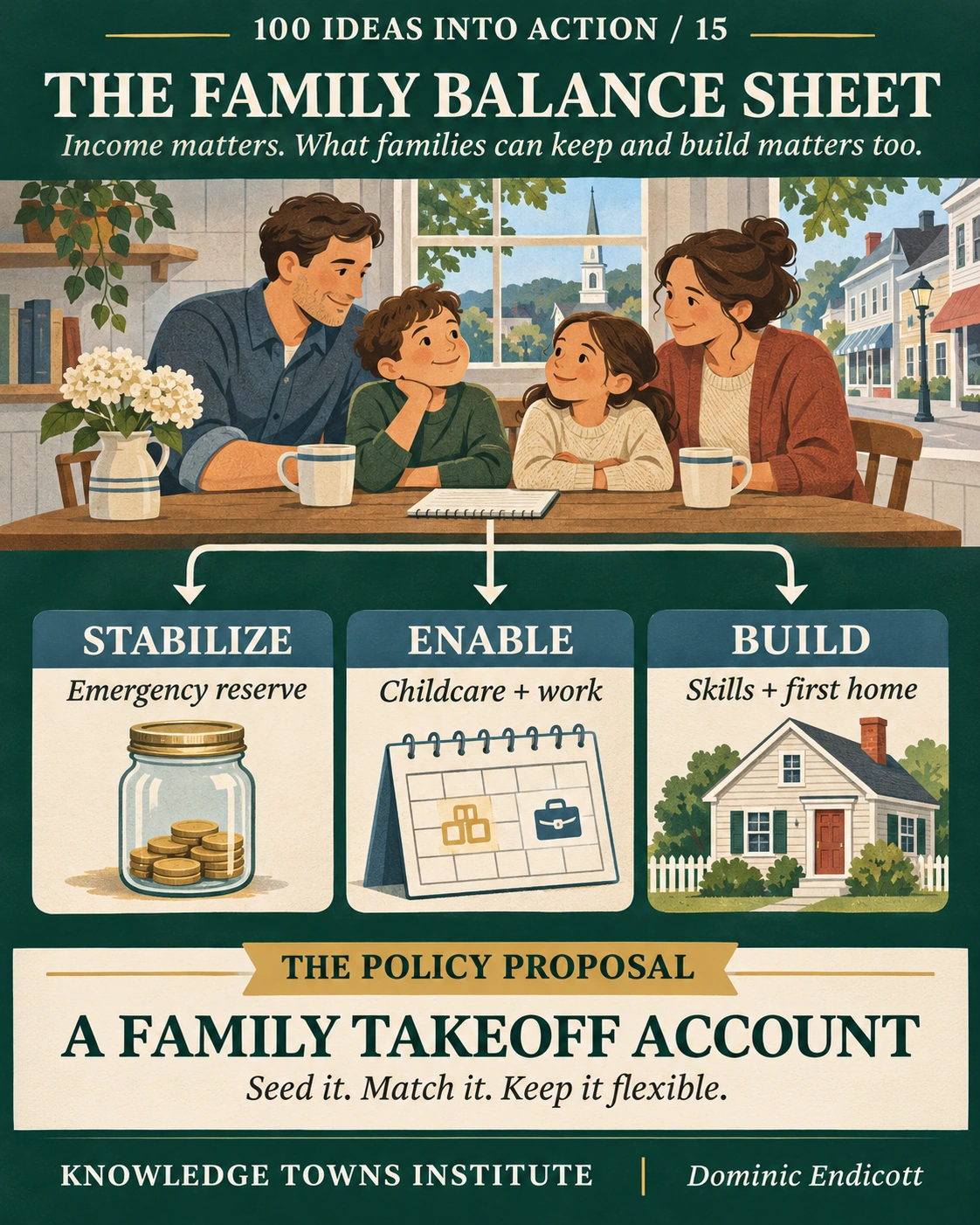
Income is only one line on the family balance sheet
A family can have two paychecks and be one car repair, childcare gap or rent increase from losing ground. Income measures the flow of money. A balance sheet asks what remains: liquid savings, manageable debt and an asset for the next move.
The proposition: Massachusetts should test a Family Takeoff Account that combines an automatic public seed with a progressive savings match. State Treasurer Deborah B. Goldberg should ask the Legislature to authorize and fund the pilot through the Office of Economic Empowerment. The Treasurer already chairs the Economic Empowerment Trust Fund and oversees the BabySteps college-savings program. This is a Knowledge Towns Institute proposal, not an announced state program or client engagement. [1]
The evidence: families face both shocks and long-term costs
The Federal Reserve’s 2025 household survey, released in May 2026, found that 73% of adults said they were doing okay or living comfortably. Yet only 63% said they could cover a $400 emergency entirely with cash or its equivalent. Fifty-nine percent had experienced at least one major unexpected expense in the previous year. The most common was a major vehicle repair or replacement. [2]
For parents, care costs can consume the margin that might otherwise become savings. The same Federal Reserve survey found median paid childcare of $1,083 a month among families paying for both care and housing. Most of those families spent at least half as much on childcare as on housing. [3]
Massachusetts’ 2026 Financial Wellbeing Scorecard illustrates the local scale of the problem. It estimates about $47,000 in annual full-time care for a family with an infant in home-based care and a four-year-old in center-based care, compared with roughly $29,000 nationally. It also estimates a $1,218 monthly grocery bill for a family of four. These are modeled reference costs, not a bill faced by every family, but they show why a household can earn a reasonable income and still struggle to accumulate liquid assets. [4]
Massachusetts has pieces of the answer
The state’s refundable Child and Family Tax Credit provides $440 for each eligible dependent from tax year 2024 onward. It is valuable cash support and should remain cash support. A savings pilot must not divert it, condition it on saving or make families wait longer for it. [5]
BabySteps offers a $50 deposit when a Massachusetts family opens a U.Fund 529 account within a year of birth or adoption. It establishes the idea that a public seed can help a family begin, but a 529 is designed for education rather than the near-term shocks that often derail work and saving. [6]
Other public programs show complementary design choices. Connecticut automatically invests $3,200 for a child whose birth is covered by Medicaid; the asset becomes available in adulthood for education, a Connecticut home or business, or retirement. Federal law now allows employers to add pension-linked emergency savings accounts, with employee contributions capped by the plan at no more than $2,500 and withdrawals available without the usual early-retirement penalty. HUD’s Family Self-Sufficiency program creates an escrow account for participating families as their earned income and rent rise. None is a full model for a flexible family account, but together they demonstrate automatic eligibility, a public seed, short-term liquidity and matched asset building. [7] [8] [9]
The instrument: a three-year Family Takeoff Account
The Treasurer should propose a $15 million appropriation for a three-year pilot serving 5,000 Massachusetts households with a child under 13. Eligibility should extend to households below 100% of area median income, with at least half of places reserved below 60%. If applications exceed places, a public lottery can allocate accounts and create a credible comparison group for evaluation.
- Seed every account. Deposit $500 when an eligible household completes a short enrollment. The seed ensures that the family with no spare cash still begins with an asset.
- Match the first dollars most heavily. Match the first $500 a family saves at 2:1 in each of two years. A family contributing $1,000 over two years could build a $3,500 balance including the seed and $2,000 match, before interest or withdrawals.
- Keep family money liquid. A participant’s own contributions must always be available without penalty. Vested public dollars should be usable for an emergency, licensed childcare that supports work, recognized education or training, or a first-home deposit. The program should define those categories broadly and allow a simple self-certified emergency withdrawal.
- Use insured deposits. Hold the account at an FDIC-insured bank or NCUA-insured credit union, with no monthly fee, overdraft, market risk or minimum balance. The state should procure a common account rather than make each family compare products.
- Make saving automatic but optional. Offer payroll splits, recurring bank transfers and deposits from tax refunds. Enrollment could be linked to tax preparation, childcare assistance and BabySteps outreach, with clear consent and an easy opt-out.
- Protect existing benefits. State law should exclude the account from state means-tested asset tests where legally possible. Before launch, the Treasurer should publish how federal programs treat the balance and seek waivers or design changes if participation could cost a family more than the match.
The economics: a bounded pilot, not a permanent entitlement
The maximum direct public contribution would be $12.5 million: $2.5 million for 5,000 seed deposits and $10 million if every family earned the full two-year match. Reserving up to $2 million for account administration, multilingual outreach, benefit screening and independent evaluation puts the maximum at $14.5 million, which fits within a $15 million authorization.
At full take-up, families would contribute $5 million of their own savings and control $17.5 million before withdrawals and interest. The maximum state cost would be $2,900 per enrolled family including the proposed administration and evaluation reserve. These figures are an appropriation scenario, not a participation forecast. Actual cost would be lower if some families did not earn the full match.
The pilot should be funded as new economic-mobility infrastructure. It should not replace the Child and Family Tax Credit, childcare assistance, rental aid or down-payment programs. Those tools address different constraints; an account helps a family retain enough capacity to use them.
The strongest objection: a savings match rewards people who can already save
That objection is serious. A family choosing between groceries and a utility bill cannot manufacture $500 for a match. A new account can also add paperwork, expose balances to benefit rules and tempt policymakers to substitute individual saving for affordable housing, childcare or adequate wages.
The design should answer directly. The automatic $500 seed gives every enrolled family a starting asset. A 2:1 match concentrates public help on the first dollars rather than rewarding large balances. Family contributions remain liquid, and the eligible uses connect short-term stability to longer-term progress. Enrollment support should be paid for; it should not be delegated to an app and a disclosure. Most important, the pilot must be additional to direct supports.
A lottery-based evaluation should compare participants with eligible applicants who receive existing services but not the account during the test period. If the result is simply that higher-income participants claim most of the match, the state should stop or redesign the program.
Practical actions and tests of success
- Within 90 days of authorization: the Treasurer should publish draft rules covering eligibility, withdrawals, benefit treatment, fees, consumer protection and data privacy, then invite public comment.
- Within 180 days: select an insured account provider, independent evaluator and community enrollment partners through open procurement. No provider should be allowed to cross-sell credit or investment products to participants.
- At launch: reserve half the places for households below 60% of area median income, use a transparent lottery when oversubscribed and publish a plain-language participant agreement in multiple languages.
- Every six months: report enrollment, deposits, match earned, withdrawals by broad purpose, fees, account access problems and benefit interactions, with privacy-protecting aggregates.
After three years, success should mean at least 75% of seeded accounts activated, a statistically credible increase in median liquid savings, fewer participants using high-cost debt for a $400 shock, no material loss of public benefits, and measurable gains in childcare continuity, work stability or completion of training. The evaluation should also report results by income, race, family structure and region.
Pause enrollment if fees erode balances, withdrawals routinely take more than two business days, a benefit cliff is discovered, complaints are unresolved or the lowest-income group cannot use the match. The purpose is practical: help a family absorb the next shock without surrendering the possibility of a home, a credential or a better job.
Evidence and status: Sources checked November 23, 2026. The Federal Reserve survey, Massachusetts tax credit, BabySteps, Connecticut Baby Bonds, pension-linked emergency savings accounts and HUD Family Self-Sufficiency program are existing evidence or programs. The Family Takeoff Account, eligibility rules, $15 million authorization, match formula and performance tests are Institute proposals. Referenced organizations are sources, not Institute partners or clients.
Primary sources
- Massachusetts: Treasurer Deborah B. Goldberg, accessed November 23, 2026.
- Federal Reserve: Economic Well-Being of U.S. Households in 2025, May 2026.
- Federal Reserve: Living Arrangements and Care Work, May 2026.
- Massachusetts: 2026 Financial Wellbeing Scorecard, 2026.
- Massachusetts Child and Family Tax Credit, updated March 11, 2026.
- Massachusetts BabySteps, accessed November 23, 2026.
- Connecticut Baby Bonds: FAQ, accessed November 23, 2026.
- U.S. Department of Labor: pension-linked emergency savings accounts, January 17, 2024.
- HUD: 2025 Family Self-Sufficiency Annual Report, 2026.
Move the idea forward
What would make a family savings pilot usable?
Contribute public evidence, a counterargument, or a practical lesson about emergency savings, childcare continuity, benefit rules or matched asset building.
Contribute to this brief ↗Please share links rather than confidential or sensitive material. Referenced organizations are sources and examples, not claimed Institute partners.